
Open MRI vs. Closed MRI: Which One Is Right for You?
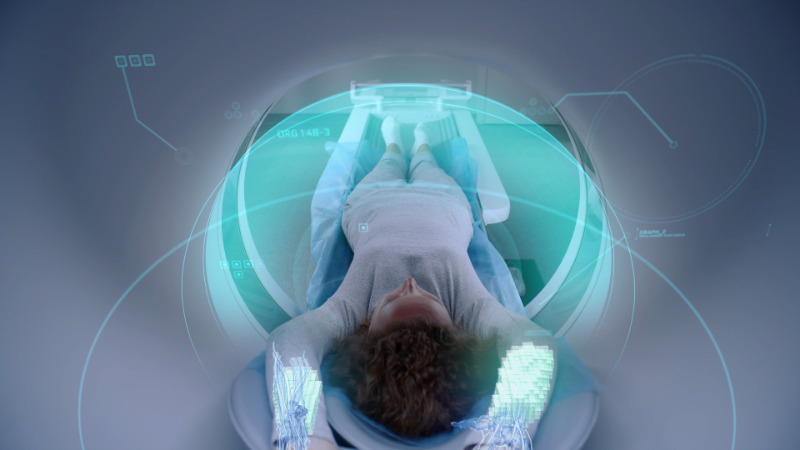
When your healthcare provider has recommended that you get MRI scans for better diagnosis and monitoring of your condition, you have options. Traditional closed MRIs are the standard, but modern, open MRIs can offer a more comfortable patient experience. Both types of MRI use the same technology, but they differ in design, patient experience, and, in some cases, imaging capabilities. Here’s what to know about closed and open MRIs and which one is best for you.
What Is an MRI?
MRI stands for Magnetic Resonance Imaging. MRI scans are non-invasive imaging diagnostics that medical providers can use to create three dimensional images of various parts of the body. They utilize strong magnetic fields and radio waves to create a reaction inside water molecules in the body and then track and record changes in a visual representation.
MRI scans allow doctors to get a detailed view inside the body and produce anatomical pictures to aid in diagnosis and monitoring of a range of conditions. The body parts that are best viewed via MRI include:
- Brain
- Spine
- Joints
- Muscles
- Internal organs
- Blood vessels (in some cases)
Once a patient’s healthcare provider decides that an MRI is necessary, they will prescribe the procedure. Then the individual will go to a facility that handles the procedure, such as Advantage Diagnostics.
Closed vs Open MRI
A closed MRI is the traditional imaging diagnostic test that features a cylindrical scanner with a tunnel-like opening. In this scenario, the patient lies on a motorized table that moves into the scanner. On the other hand, an open MRI is not closed on the sides and features a more spacious design with greater visibility on all sides. There is increased space around the patient, and the overall design is purpose-driven to make MRI scans more comfortable for certain individuals.
Both closed and open MRIs use non-invasive magnetic fields and radio waves to create detailed images of the body's internal structures, and both produce high-quality images that inform healthcare providers and help them diagnose, monitor, and treat various conditions. Both forms of MRI scans also require patients to remain as still as possible for the most accurate imaging, and both are suitable for many complex imaging diagnostics studies. Some exams may take more time than others regardless of scanner design, and while both open and closed MRI systems produce loud tapping or knocking sounds during the scan, patients are always provided with some form of hearing protection.
While closed MRIs are more common and widely available, open MRI scans are a specialty service that is less common. Advantage Diagnostics is proud to offer this service to our patients.
When To Choose Open MRI Scans
The right type of MRI for you depends on several factors, including the area being examined, your comfort level, and your healthcare provider's recommendations. In some cases, a closed MRI may be preferred for certain specialized imaging diagnostics. But this is not always the case. More often than not, a patient can decide whether a closed or open MRI works best for them when they discuss options with their physician.
In general, open MRI scans are commonly recommended for:
- Patients with claustrophobia or anxiety
- Children (when appropriate)
- Individuals who have difficulty remaining in enclosed spaces
Anyone who may feel more comfortable in an open setting with less of an enclosed feeling as opposed to the very confined environment of a standard closed MRI should discuss the available options with their prescribing physician. To learn more about our open MRI services and how to prepare for your MRI, feel free to contact the staff at Advantage Diagnostics.
Work With An Accredited Imaging Diagnostics Center
At Advantage Diagnostics, we know that learning you have a serious health concern can be troubling, and worrying about the tests needed to diagnose, monitor and treat your condition can be overwhelming. That’s why we’re so happy to offer open MRI services to our patients. Open MRI scans are far more comfortable and are better tolerated when compared to traditional closed MRI scans. When you work with Advantage Diagnostics, you can trust that we will thoroughly explain the imaging diagnostics test you will undergo, along with prioritizing your comfort and producing high-quality diagnostic images for your physician. After your test, our doctors interpret the results and communicate their findings with your doctor as soon as possible. Contact us today to learn which of our locations is most convenient for you, to request or submit a patient referral form, and to learn more about our suite of services.